|
|
|
08_february_07 (updated references summer 2012)
Introduction
The Frugel-Horn
(the name is a cross between flugelhorn & frugal) is an open-source DIY
project to develop a small, inexpensive, full-range rear-loaded corner horn. The
design has reached version 1.0 -- in a number of variations -- with a well developed
set of plans available (obselete now). For those interested in how we got to here,
check the history page.
04_may_10 Breaking News: If you think
because this is an inexpensive diy project it is not worthy, Ring Audio was about to market a development
of the Frugel-Horn costing 1,000s of Euros. Dr. Goran Tomljenovic's 1st FH has been
in the Gallery (he sent pictures July 06). Discussion here.
Note 2: Since the FE126e has been discontinued development work on the Frugel-Horn
Mk 2. The 1st development ideas for Frugel-Horn Mk 3 for a number of current drivers
are already passing back & forth.
Small & full-range horn are 2 words you don't really see together very often.
How low a horn* can go is determined by its mouth size. Low frequency cutoff of a
circular horn is the frequency with a wavelength the same size as the circumference
of the horn mouth -- converted to a square we are talking about a mouth 16 ft x 16
ft for true 20 Hz horn bass.
* (most "horns",
including the Frugel-Horn are actually hybrid TL/horns. Below a given frequency the
mouth is not large enough to damp the pipe resonances giving undamped TL action.
Above this frequency the mouth becomes large enough to provide the horn damping and
you transition to a horn loading.) |
|
By using a smallish
driver (Fostex FE126), setting realistic bass targets, and by using a corner (which
multiplies the effective mouth size by 8 times), just such a beast has been created.
This is not the 1st time this has been done -- little in audio is and one of the
more recent notable examples is Ed Schilling's justifiably famous Hornshoppe Horn. Its stellar performance has
earned it a Stereophile Class C ranking. The genesis of the
Frugel-Horn, arose from someone on an audio forum asking the question "DIY design
similar to hornshoppe?" on the old Decware forum (you'll have to look on the
way-back machine for any hope of reading it).
The Frugel-Horn has
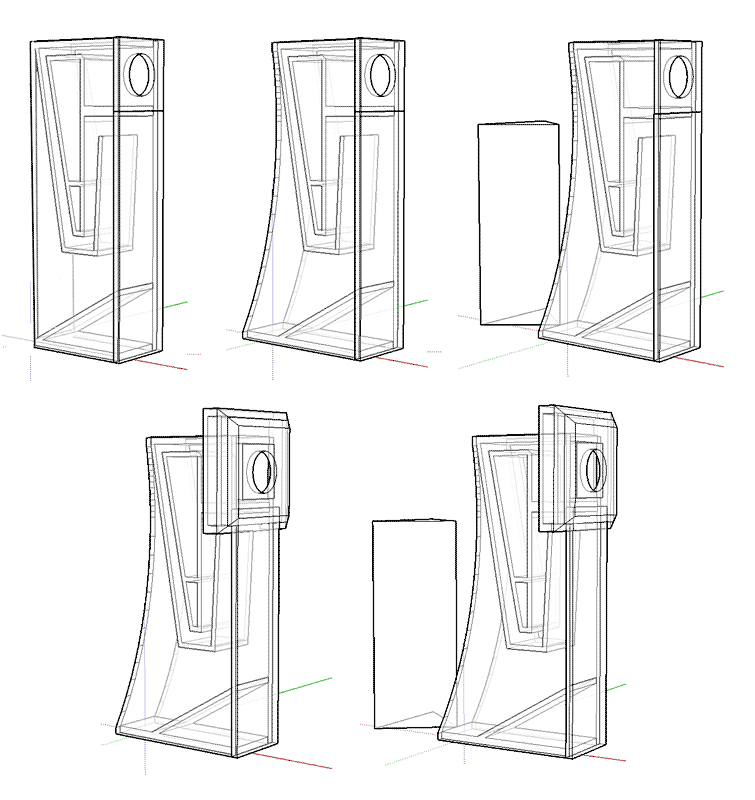
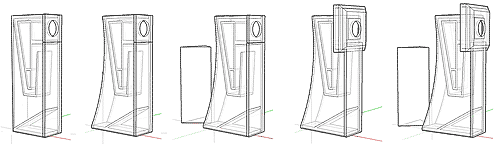
some features not often seen. It can be built to 4 different levels, in 5 basic configurations.
In its basic Level 0 trim it is a rectangular box a bit bigger than Ed's Horn. In
full Level 3 build, it is a decidedly non-rectangular box with a mouth-size that
gives theoretical potential of fully horn-loaded bass to 75 Hz (half an octave lower
than an L0 build) when properly loaded into a corner. The 3 elements that turn an
L0 into an L3 -- the curved exit, the deflector, and the supraBaffle ...borrowed
from Ron Clarke's designs -- Ron designed the rear of the Frugel-Horn. See the technical
page for more info.
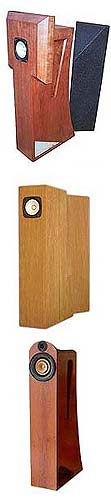
Another intention of the design is to leave latitude for builders to impress their
own artistic vision on the finished product. As well as the different technical elements,
there are some elements that are more artistic in nature, most notably the opening
up of the voids. Already some very elegant & beautiful variations have been brought
to life.
Ignoring the builder's time, investment in tools, and cabinet finish, a pair of Frugel-Horns
can be built using with the Fostex FE126E for ~$250/pr. If you have the wood lying
around and a set of less expensive drivers you could have a pair of speakers for
much less. Based on results from recent experience with cabinet materials on other
designs, we would strongly recommend Baltic birch plywood for construction, but feel
free to experiment with any other sheet goods or even solid hardwoods.
Frugel-Horn Discussion Threads:
|